
Gigantes Island Philippines Guide: Beaches, Lagoons, Caves, and Local Culture
Explore Gigantes Island Philippines with beaches, lagoons, caves, sandbars, local culture, official attractions, weather tips, meals, and responsible travel.
[ADS]
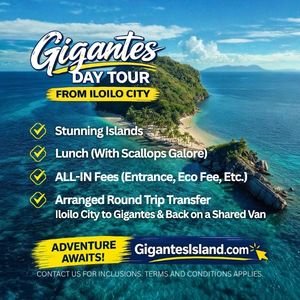
* Book Now, Pay Reservation Later, Balance on Your Tour Date. Terms and Conditions Apply. Subject to Availability.
Gigantes Island Philippines is one of the Visayas’ distinctive island-hopping destinations, combining white-sand beaches, shifting sandbars, limestone scenery, saltwater lagoons, caves, heritage sites, and working fishing communities within the wider municipality of Carles, Iloilo. It is especially convenient for domestic travelers coming from Iloilo, Bacolod, Cebu, and other parts of the Visayas, while visitors from elsewhere in the Philippines can connect through Iloilo or Roxas before continuing north to Carles.
The attraction of Gigantes is not a single beach or famous photograph. A typical trip is a boat-based journey between multiple islands and coastal stops, each offering a different experience. One stop may be primarily for swimming, another for a viewpoint, another for a sandbar, and another for lunch or a glimpse of everyday island life.
Travelers should plan the destination as a living coastal environment rather than a purpose-built resort. Fishing boats, island communities, changing tides, weather, marine conditions, and local tourism procedures all influence how the experience unfolds.
Bancal Port Is the Official Gateway to the Islands
Under Municipal Ordinance No. 2016-03, Bancal Port in Barangay Bancal, Carles, Iloilo, is designated as the official entrance and exit point and gateway to the municipality’s island destinations.
Visitors normally report through the Bancal tourism system and complete the current procedures required for authorized island travel. Depending on the arrangement and current operating requirements, this can involve passenger verification, Tourism Pass procedures, documented fees, safety instructions, boat assignment, life-jacket preparation, loading, and maritime clearance.
Travelers should therefore avoid treating the port as a place where they can simply arrive at the last minute and immediately board a boat.
Read the Bancal Port guide before traveling so the road transfer, registration, and boat departure are planned as one continuous journey.
Exploring the Official Carles Tourism Destination List
The Carles Tourism materials identify 13 featured destinations covering both the Gigantes group and Sicogon. These names provide a useful official framework for understanding the wider tourism area.
| Official Destination | What Makes It Distinct |
|---|---|
| Tangke Lagoon | A saltwater lagoon enclosed by limestone or karst formations |
| Cabugao Gamay Island | The widely photographed “selfie island” with an elevated viewpoint |
| Cabugao Dako Island | A larger neighboring island associated with beach and coastal scenery |
| Bantigue Island and Sandbar | A sandbar experience whose shape and exposure change with the tide |
| Antonia Point | A white-sand stop known for coastal scenery and layered rock formations |
| Ojatras Island (Pulupandan) | A small island known for creamy-white sand and turquoise water |
| Mini Boracay (Calumpang) | A small fine-white-sand beach surrounded by vegetation and rock formations |
| Tinagong Bay-Bay (Dakong Bay-Bay) | A small fine-white-sand coastal attraction |
| Century-Old Lighthouse | A historic landmark on Gigantes Norte |
| Sicogon Island | A major island destination with its own beaches, communities, and tourism sites |
| Tumaquin Islet | An islet included in the official Carles tourism destination list |
| Mt. Opao | A mountain attraction on Sicogon Island requiring appropriate hiking preparation |
| Sicogon’s Lagoon Eco-Trail | A nature attraction on Sicogon with access arrangements that should be confirmed before travel |
This list should not be interpreted as a promise that every visitor will see all 13 destinations in one day. Actual routes depend on the booked product, operating provider, available time, tides, weather, passenger pace, and safety conditions.
Use the Gigantes and Carles destinations guide when comparing the different stops.
Tour Routes Are Flexible, Not Guaranteed Checklists
Tour sellers may use names such as Tour A, Tour B, or a combined Sicogon–Gigantes tour, but these are operator-defined products rather than standardized official routes.
Before paying, request the planned itinerary in writing and understand that the captain or authorized guide may:
- Reorder stops
- Shorten the time at an attraction
- Replace an unsafe landing
- Skip a location
- Postpone a departure
- Cancel the route when conditions are unsafe
Wind, waves, tides, visibility, crowding, daylight, maritime advisories, and local restrictions can all affect what is realistically possible.
The Gigantes Island hopping guide explains how boat-based routes are commonly organized and why flexibility is essential.
Why Cabugao Gamay Is Only One Part of the Full Experience
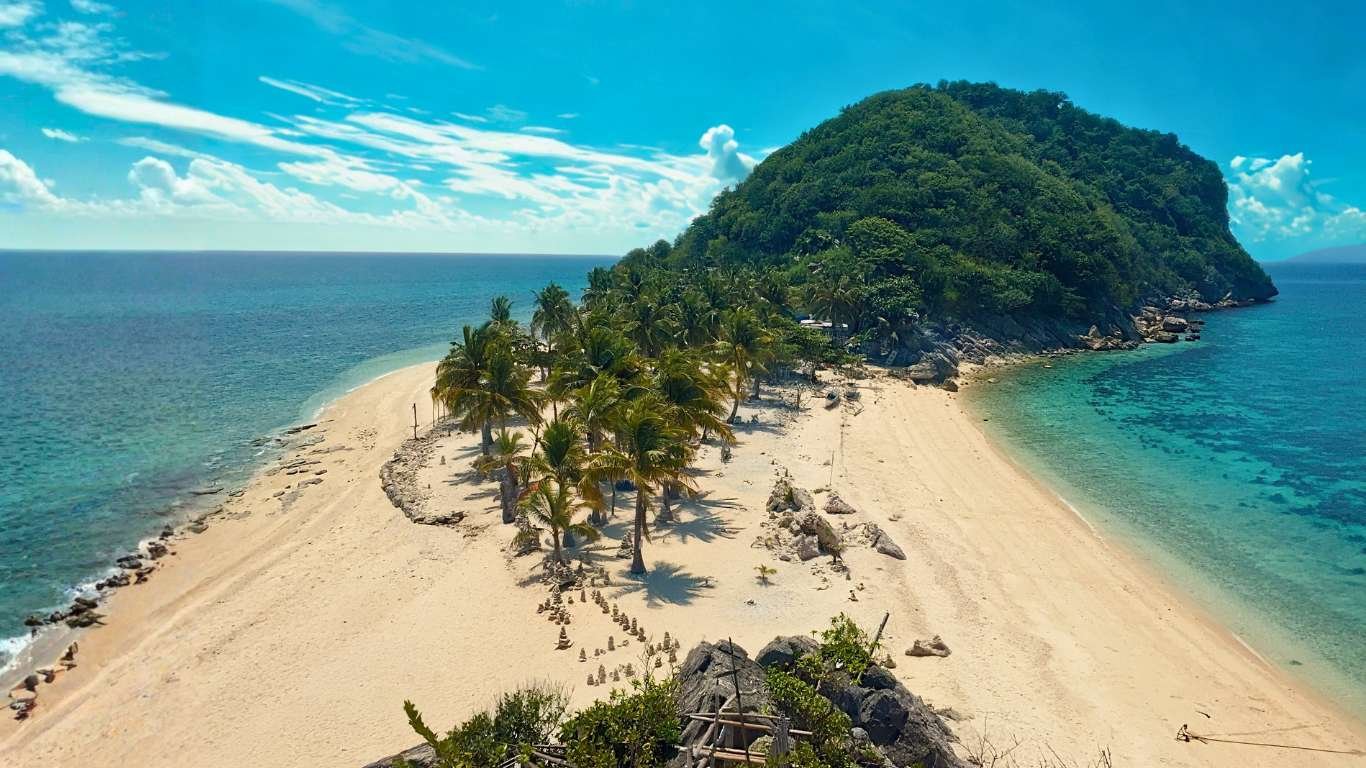
Cabugao Gamay is the most recognizable photographic landmark in the Gigantes group. Its narrow central beach, limestone ends, tropical vegetation, surrounding blue water, and elevated viewpoint make it especially memorable in photographs.
The island also gained international online exposure after appearing in a 2016 Forbes article featuring a Beautiful Destinations selection of scenic places. That exposure helped make Cabugao Gamay one of the images travelers frequently associate with Iloilo and Gigantes.
However, visitors should not reduce the entire destination to that single image or an old online feature.
The wider Gigantes experience includes:
- Swimming stops
- Sandbars exposed differently with the tide
- Limestone landscapes
- Saltwater lagoon scenery
- Island communities
- Historic sites
- Caves and land attractions on selected itineraries
- Fresh seafood and shared Filipino meals
- The experience of traveling between islands by local boat
Someone who visits only to recreate one famous photograph misses much of what makes Gigantes Island Philippines distinctive.
For practical information on the viewpoint, beach, crowding, and safe access, see the Cabugao Gamay Island guide.
Beaches, Sandbars, and Lagoons Change With Nature
Promotional photographs often capture an attraction at an especially favorable tide, light level, or sea condition. Travelers should not expect every stop to look exactly the same throughout the day or year.
At Bantigue, for example, the visible size and form of the sandbar can change with the tide. Tangke Lagoon access can also depend on tide, sea conditions, and local safety decisions.
Water clarity and beach width can change with:
- Tide
- Recent rainfall
- Wind
- Wave action
- Seasonal conditions
- Boat traffic
This variability is part of visiting a natural marine destination rather than a controlled swimming pool or artificial beach resort.
Weather Seasons Versus Short-Range Forecasts and Maritime Decisions
Western Visayas generally experiences relatively drier periods and wetter monsoon periods, but a seasonal label should never be treated as a guarantee of calm weather or smooth seas.
Rain, thunderstorms, wind, swell, and rough sea conditions can occur during any month.
Likewise, a trip during a generally wetter part of the year does not mean every day will be unsuitable for touring.
For Better Weather Planning:
- Look at short-range forecasts close to departure.
- Ask the operator for the latest local conditions.
- Allow flexibility for route changes.
- Avoid scheduling a critical onward connection immediately after the tour.
- Follow Coast Guard, captain, and authorized maritime decisions.
The most important weather information is often the condition expected on the actual travel date rather than a general statement about the month.
A captain’s decision to alter or cancel a route for safety should be respected even when travelers have already paid for accommodation, transportation, or onward flights.
Choosing a Verified Tourism Operator
Groups, families, and company outings should use currently authorized tourism providers and confirm the actual business responsible for the service.
Before payment, request clear information about:
- The operating tour provider
- The boat or transport arrangement
- Meeting point
- Tour inclusions and exclusions
- Passenger capacity
- Meals
- Fees
- Payment schedule
- Weather policy
- Cancellation or refund terms
Do not select a provider solely because of the lowest advertised price. Safe passenger capacity, life-jacket availability, reliable communication, and clear responsibility for the service are more important.
Identification for Domestic and International Travelers
Domestic travelers should carry a government-issued ID that matches the name used for transport, accommodation, or other reservations where identification is required.
Foreign visitors should keep their passport secure and maintain a protected copy of the identity page for travel records. Do not leave the only passport copy in cloud storage because mobile data can be unreliable in remote areas.
Keep Important Travel Records Accessible Offline
- Government-issued ID or secure passport information
- Hotel confirmation
- Tour confirmation
- Transport details
- Emergency contacts
- Travel-insurance information
Protect documents and electronics inside a waterproof pouch or dry bag during boat travel.
Children and Discounted-Fare Requirements
Families traveling with children should confirm requirements before departure rather than assuming that a discounted or free child rate eliminates documentation or capacity considerations.
Ask the provider about:
- Age basis for the child rate
- Identification or proof of age required
- Boat passenger counting
- Child-size life jackets
- Meal inclusion
- Sleeping arrangements for overnight packages
- Physical requirements at viewpoints or land attractions
Infants and children still form part of safe passenger-capacity planning even when a seller offers a reduced rate.
Meals, Seafood, and Dietary Planning
Fishing has historically been an important livelihood in Carles, and seafood is naturally a major part of the local food experience. Island-hopping lunches commonly feature simple Filipino dishes served for sharing, often accompanied by rice and locally available seafood.
Travelers with allergies, vegetarian requirements, religious dietary restrictions, or other food needs should communicate them during booking.
Tell the Operator in Advance About:
- Shellfish allergies
- Fish allergies
- Other serious food allergies
- Vegetarian requirements
- Food restrictions for children
- Medical dietary needs
Remote lunch stops may have limited ingredients and cannot always prepare a replacement meal immediately. Advance notice gives the operator a better chance to make an appropriate arrangement.
Travelers with severe allergies should also carry any prescribed emergency medication and should not assume that an isolated island stop has specialized medical supplies.
Carry Drinking Water and Small-Denomination Cash
Even when lunch is included, travelers should carry personal drinking water unless the package clearly provides enough for the day.
Small-denomination Philippine pesos can also be useful for legitimate expenses excluded from the package, such as optional food, drinks, local transportation, or small vendor purchases.
Do not depend completely on credit cards, ATMs, or mobile-wallet payments after leaving a major commercial center. Mobile connectivity and electronic-payment acceptance may be limited.
Respectful Travel in Fishing Communities
Gigantes is not an uninhabited movie set. People live, raise families, fish, repair boats, prepare meals, transport supplies, and work in the places visitors pass through.
Responsible tourism means treating residents with the same courtesy expected in any community.
When Visiting Community Areas:
- Ask before photographing identifiable residents.
- Ask permission before photographing children.
- Do not enter private yards or homes for pictures.
- Do not treat fishing boats as photography props without permission.
- Keep working paths and boat-loading areas clear.
- Do not interfere with nets, equipment, or catches.
- Follow community rules and quiet-hour expectations.
A family home overlooking the sea remains a private home even when tourists find the setting picturesque.
Supporting Small Vendors Respectfully
Buying snacks, drinks, seafood, or simple local products can help direct visitor spending into island communities.
Ask the price before buying, but avoid aggressive bargaining over very small amounts simply because the seller operates in a remote community. Transporting supplies to islands can involve additional boat costs, storage limitations, and weather-dependent deliveries.
Travelers should also carry smaller bills because small vendors may not have enough change for large notes.
Protecting Beaches, Lagoons, Caves, and Marine Areas
Visitors must not remove natural materials from the destination. Under the applicable Carles tourism rules, the extraction or collection of natural resources such as sand, pebbles, rocks, shells, and similar materials is prohibited.
Leave shells, coral, stones, cave materials, and other natural objects where they belong.
Responsible Marine Travel Means:
- Do not litter.
- Carry reusable containers when practical.
- Take personal waste back to an appropriate disposal point.
- Do not stand on or damage coral.
- Do not chase or handle marine wildlife.
- Do not remove shells or beach materials.
- Follow swimming boundaries.
- Respect marine protected and restricted areas.
A beautiful island remains beautiful only when visitors avoid leaving waste or physically altering the place they came to enjoy.
Responsible Photography at Natural Attractions
Photo stops can become crowded when several boats arrive close together. Visitors should avoid blocking stairs, narrow paths, boarding areas, and viewpoints while repeatedly taking photographs.
At elevated locations such as Cabugao Gamay, secure footwear is more important than recreating a particular pose. At beaches and rocky areas, wet surfaces can become slippery.
Do not climb unstable formations, cross barriers, or approach unsafe edges for a more dramatic photograph.
Practical Gigantes Island Philippines Checklist
- Confirm Bancal Port as the official gateway for the booked island trip.
- Use a currently verified and authorized tourism operator.
- Request the itinerary, inclusions, exclusions, and weather policy in writing.
- Understand that Tour A, Tour B, and similar names are operator-defined.
- Do not expect all 13 official Carles destinations in one day.
- Check short-range weather close to departure.
- Follow the captain’s and maritime authorities’ safety decisions.
- Carry government-issued identification where required.
- Keep passport copies and booking records secure if traveling internationally.
- Confirm child documentation, capacity, and life-jacket arrangements.
- Report food allergies and dietary restrictions before the tour.
- Bring sufficient drinking water.
- Carry enough Philippine pesos and smaller bills.
- Protect cash, identification, phones, and electronics from water.
- Ask permission before photographing residents or children.
- Keep clear of fishing work areas.
- Do not enter homes or use private boats as props without permission.
- Support local vendors respectfully.
- Do not remove sand, shells, coral, rocks, or other natural materials.
- Take waste back to an appropriate disposal point.
- Accept itinerary changes when weather or sea conditions require them.
Seeing Gigantes as More Than a Famous Photo
The appeal of Gigantes Island Philippines comes from variety. Cabugao Gamay may be the face many travelers recognize first, but the wider destination includes limestone cliffs, changing sandbars, coastal lagoons, beaches, caves, heritage landmarks, Sicogon attractions, fishing communities, seafood meals, and the simple experience of moving across the Visayan Sea from one island to another.
The most rewarding visit is not necessarily the one that checks the greatest number of attractions. It is the one planned with enough time, flexibility, safety awareness, and respect for the people and environments that make the destination possible.
Explore the wider collection of places through the Gigantes Island attractions guide, then use the Gigantes Island travel guide to coordinate transportation, port procedures, accommodation, cash, weather, packing, and responsible island hopping.
Book your Gigantes Island hopping experience at GigantesIsland.com/book, or visit GigantesIsland.com/frequently-asked-questions to learn more.
The 10th Annual Divi Marathon
Lorem ipsum dolor sit amet, consectetuer adipiscing elit, sed diam nonummy nibh euismod tincidunt ut laoreet dolore magna aliquam erat volutpat.
